Why We Started Wee Foragers
A Froebelian approach to food and sustainability, nurturing the whole child through nature, play, and purposeful experiences.

By Louise Licznerski
Owner/Founder

A Growing Unease
It began at home, in the ordinary rhythm of family life, in the small moments that you almost dismiss at first. As parents, Paul and I started to notice changes in our own children that we couldn’t quite explain away. There were shifts in behaviour, dips in energy, moments of dysregulation that felt out of character, and alongside that, things like skin rashes and sensitivities that seemed to appear without clear cause.
At first, you question everything else. Sleep, routines, transitions, the pace of life. But slowly, and almost reluctantly, we found ourselves looking at something we had perhaps taken for granted food.
The more we paid attention, the more uncomfortable it became. So much of what is readily available is factory made, heavily processed, stripped of nutritional value and yet designed to be appealing and convenient. And as we began to make changes at home, even small ones, we started to see a difference. Not in a dramatic or immediate way, but enough to know that it mattered.
That realisation stayed with us. Because if we were seeing this in our own children, what was happening more widely?
When You Start to Notice Patterns
It is never as simple as drawing a straight line between cause and effect, but when you spend your days alongside children, patterns begin to emerge. You see the child who cannot settle, the one who is desperate to concentrate but cannot quite hold onto the thread of their thinking, the one whose body seems to be telling a story that words cannot yet express. And you begin to ask questions, not just as practitioners, but as parents. What are we feeding our children, and what is that food doing for them—or to them?
Wee Foragers grew from those questions. It was never about creating a business in the traditional sense, but about reclaiming something that felt as though it had quietly slipped away from us. We wanted our children to know their food, to understand it, to feel connected to it in a way that goes far beyond what appears on a plate.
From Little Bugs to Wee Foragers
Through our work at Little Bugs, we had already begun to see what happens when children are given time, space, and trust to form real relationships with the natural world. Friedrich Froebel spoke of this as the unity between the child, nature, and the wider world, a belief that learning is not delivered but unfolds through connection and experience.
In our nurseries, this is not theory, it is daily life. Children collect eggs from chickens, not as a task, but as part of a relationship built over time. They plant seeds and return to them, again and again, noticing change, responding to what is needed, beginning to understand growth not as an outcome but as a process.
There is a quiet depth in these moments. Froebel wrote about self-activity, the idea that children must be active participants in their own learning, and it is exactly this that we see when a child tends to something living.
What became increasingly important to us was that this ethos did not stop at the edge of the outdoor space. It felt contradictory to nurture this deep connection to land, to growth, to care, and then offer food that told a completely different story. We wanted the same principles to flow through everything, including what children were eating across our nurseries. Wee Foragers became the natural extension of that thinking.
Learning for Sustainability…Lived Daily
The Scottish Government’s Learning for Sustainability agenda speaks about developing “a sense of connection to the natural world and a responsibility to care for it.” That idea of responsibility is not something that can be taught in isolation; it has to be experienced.
When children begin to understand that caring for chickens leads to eggs, that tending soil leads to food, that leaving space for insects brings birds, they are not just learning about the world, they are understanding their place within it.
The same guidance reminds us of the importance of “caring for our outdoor spaces” as part of caring for ourselves and our communities. Food sits right at the centre of that. When children are nourished with whole, seasonal, thoughtfully prepared food, there is a steadiness that follows, a capacity to engage, to regulate, to be present.
Rooted in Scotland
In Scotland, we are surrounded by an abundance that is often overlooked. Some of the finest produce in the world is grown here, shaped by our land, our climate, and our seasons. Yet so often, the food reaching our children has travelled vast distances, disconnected from any sense of place.
Froebel’s emphasis on the child’s immediate environment feels particularly relevant here, the idea that learning begins with what is close, familiar, and real. By reconnecting children with local, seasonal produce, we are grounding their understanding in something tangible, something they can see, touch, and taste.
The Role of the Chef
What has brought this to life in ways we could never have fully imagined is the presence of Vas in our work. His approach to food transforms it from something functional into something deeply engaging and creative.
There is a Froebelian thread here too, the idea that materials should be open-ended, capable of becoming something more through the child’s interaction with them. Food becomes a material for exploration, not just something to consume. A simple ingredient holds endless possibility when curiosity is allowed to lead.
A Seasonal Moment: Wild Garlic Pasta
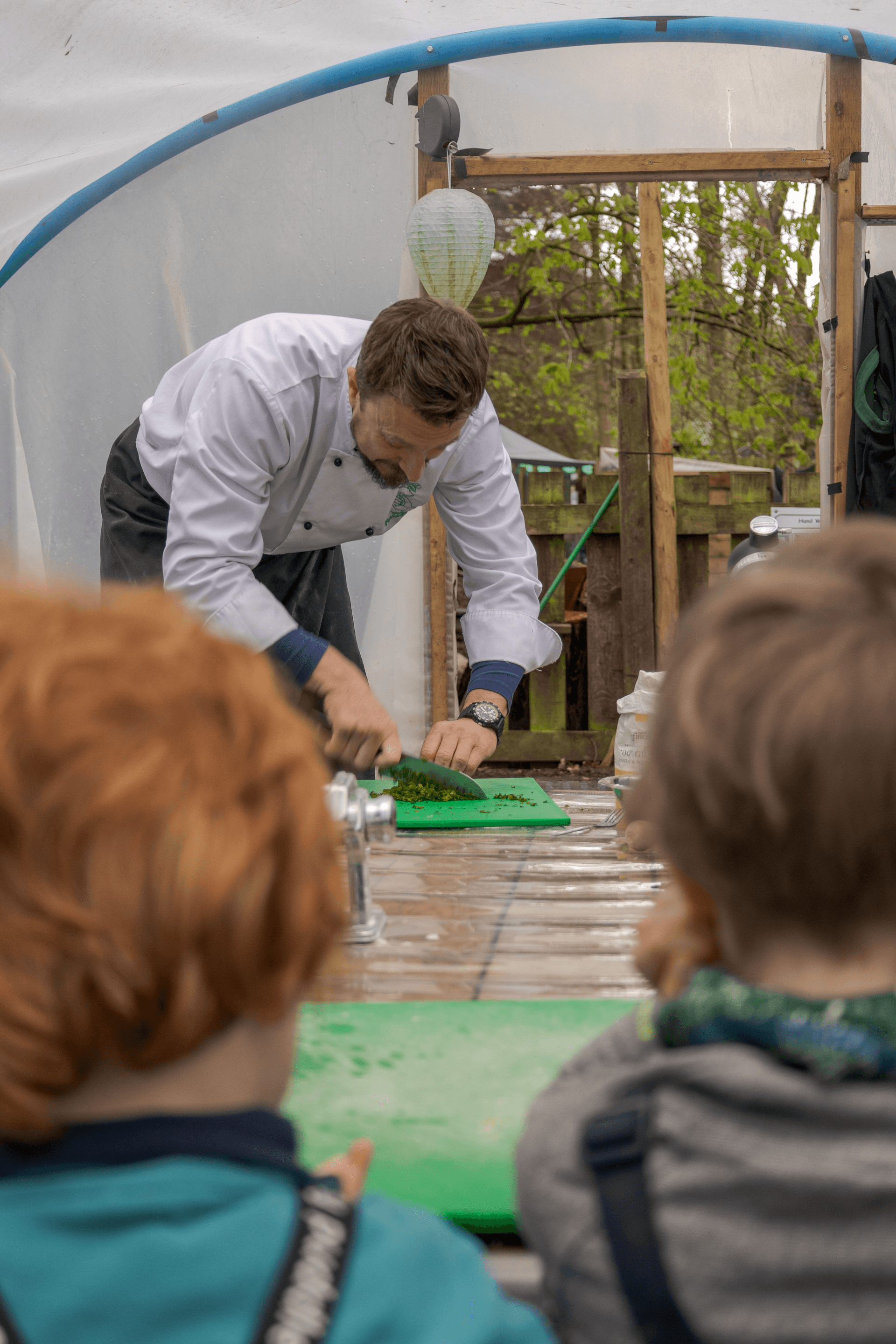
This week, this came together in a way that felt almost like a living expression of everything we believe in. The children set out to forage for wild garlic, moving through the space with a sense of purpose, learning how to identify it, noticing where it grows, understanding that it appears only at certain times of the year.
There was a deep attentiveness in their actions, a kind of quiet respect that comes when children feel part of something rather than separate from it.
From there, the experience flowed into preparation, into chopping and mixing, into the unfamiliar but deeply satisfying process of making pasta from scratch. Conversations emerged organically, about where pasta comes from, about how food travels across cultures, about how something so simple can connect us to places far beyond our immediate environment.
What was particularly striking was the level of engagement across the group. Children who often struggle to focus were completely absorbed in the process, sustained in their attention in a way that felt both natural and effortless. Children with additional support needs joined in fully, not on the edges but at the centre of the experience, able to create something alongside their peers that felt equal, meaningful, and valued. There was a sense of pride, of capability, of joy that filled the space.
And then they ate it. Food they had found, prepared, and created together.
When Learning Becomes Play
What stayed with me most was what happened afterwards. The experience did not end with the meal; it deepened.
In the mud kitchen, the pasta maker reappeared, this time led entirely by the children. Grass became seasoning, water became sauce, and the process was reimagined through their own ideas. Friedrich Froebel spoke of play as the highest expression of human development, and it is hard to argue with that when you see learning being revisited, reshaped, and extended in this way.
This was not imitation, it was transformation.

A Way of Thinking, Not Just Eating
As I reflect on this journey, I find myself returning again and again to Froebel’s belief in connection, in unity, in the idea that education should nurture the whole child in relation to the world around them.
Wee Foragers is not just about food. It is about recognising that food sits at the intersection of wellbeing, learning, and sustainability. It is about slowing down enough for children to experience where things come from, to ask questions, to care.
Where This Is Leading
It continues to grow, not in a way that feels rushed or forced, but in response to the children, to the seasons, to the relationships that shape it.
And what feels increasingly clear is that when children are given the opportunity to truly know their food, to participate in its journey, and to experience the joy that comes with that, something shifts.
They begin to care.
Not because they are told to, but because they understand why it matters.
And perhaps that is where real sustainability begins.
More from the blog

When Did Early Years Become Two Jobs for the Price of One?
Scotland tells us that the early years are some of the most important years of a child's life. Our curriculum and inspection system increasingly expect practitioners to be educators as well as carers.


What Learning from Educators across the United States made me Question about the Future of Scottish Education
“Educational evolution can only happen where there is enough freedom for new ideas to grow.”

More Hours. Less Choice. Why Scotland’s Childcare System Risks Driving Innovation Away
After more than a decade working across Scottish education and building outdoor learning provision, I have become increasingly concerned about the widening gap between Scotland's child-centred ambitions and the reality many families experience. This article explores why...